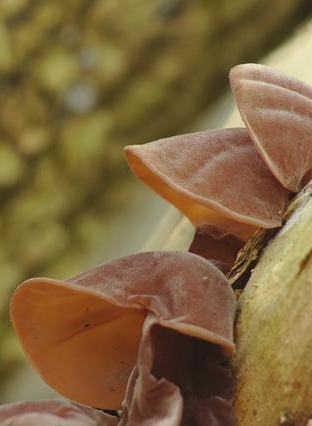
Wood ear
Auricularia auricula-judae
Auricula is a Latin word that means ear.
Judae means Judas, the Jew who is said to have betrayed Jesus.

Other, even older common names for this species include Wood Ear and Judas' Ear - the latter a connection with the belief that Judas Iscariot hanged himself on an Elder tree after betraying Jesus Christ.

The legend, which dates back more than four hundred years, claims that the fulgal 'ears' that emerge from Elder wood are Judas's returned spirit.

Name: Wood ear, Auricularia auricula-judae
Other names:Black fungus, Jelly ear fungus, Judas ear, Jew’s ear
Family: Auriculariaceae
Harvest months: throughout the year, but most commonly from apr-jun
Usable plant parts: everything
Appearance: The entire fruiting body is a thin, irregular disc (may be ear-shaped) that has a rubbery texture.
There are no gills or stem.
The color is usually pinkish or yellowish brown.
Habitant: Widespread worldwide, grows primarily on damaged wood, especially elderberry
Risk of confusion: Umbilicaria mammulata
Toxicity: non-toxic
Warning: Should not be taken with blood thinners. Pregnant or nursing women should avoid it as it may have contraceptive effects.
Ingredients: polysaccharides, bioactive phenols, adenosine
Properties: tinitus, migraine, tension headache, anti-cholesterol, anticoagulant , antimicrobial, anti-inflammatory
Helps with: Hemorrhoids, uterine bleeding, moisten mucous membranes, high blood pressure, relieve irritating coughs
Plant uses
Cooking:
Edible, but lacking flavor. Closely related species from the Asian region are cultivated, and marketed as fasting and medicinal mushrooms.

Health:
Thanks to polysaccharides, the mushroom has a cardioprotective effect, which can reduce oxidative damage to cell membranes.

Beauty:
None.