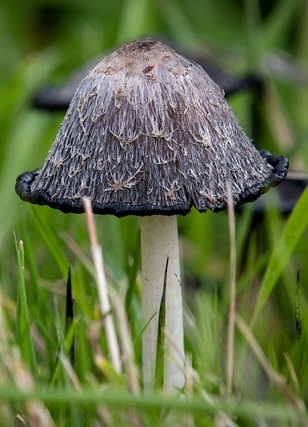
Shaggy mane
Coprinus comatus
From ancient times to the Middle Ages,
the shaggy mane was used to make writing ink by melting a few specimens in a bowl,
skimming off the liquid, and mixing it with gum arabic and clove oil.
The ink itself is still used to color dishes and in recipes for its distinctive natural food dye.
Name: Shaggy mane, Coprinus comatus
Other names: Lawyers wig, JiTui mo, Mao Tou Gui san
Family: Champignon relatives (Agaricaceae)
Harvest months: Apr-Nov
Usable plant parts: Fruiting body, cap, stalk
Appearance: Cap is columnar or ovoid, creamy white with fringed scales on top.
Usually, the top of the cap has a subtle brown to ocher coloration.
Over time, the cap edges begin to curl upward, taking on a bell-shaped appearance and melting into a black liquid.
The fruiting body can reach a height of up to 20 centimeters.
It is hollow with a fugitive ring and thickened stem base.
The lamellae are first white to pale pink. With age, they turn black and liquefy along with the cap flesh.
The spores are black.
Habitat: loamy soils, meadows, forest clearings, gardens
Danger of confusion: common inkey cap (also edible)
Toxicity: non-toxic
Warning: After consumption or ingestion of crested pints, a harmless blackening of the stool may occur.
Ingredients: beta-glucan, essential amino acids, polysaccharides, vitamin B, vitamin B2, vitamin B3, vitamin C
Properties: antibacterial, anticarcinogenic, blood lipid-lowering, digestive
Helps with: blood sugar, diabetes, circulatory disorders, diseases of the intestine
Plant uses
Cooking:
Edible, but because it does not keep very long and - once harvested -
must be processed as quickly as possible, it is practically not offered in stores.
They’re good for pairing with simple dishes, like pasta or chicken.
Health:
The shaggy mane is one of the few vital mushrooms that contain vitamin C.
In addition, 20 free amino acids have been detected in the protein of the crested pineapple -
including all eight essential ones that the body cannot produce on its own.
It is used to prevent hemorrhoidal disorders and to increase digestive activity.
Its antibacterial and antifungal properties also work in favor of a healthy intestinal microbiome.
Medical studies show that extracts from this mushroom can lower blood glucose levels.
Beauty:
None.