Elder
Sambucus nigra
Since ancient times, elder has been dedicated to Miss Holle, the earth goddess.
It represents a gateway to the underworld and according to old folk belief,
elder could keep away negative influences from outside, attract negativity from house,
yard and stable and drain it into the earth.
In addition, it was believed that elderberry could take away diseases from people through offerings that were placed under the bush.
It was also considered a protective shrub against evil spirits and demons.
In ancient England, morticians always carried some elder wood for protection,
and in America you can still find many cemeteries with elder bushes planted there to ward off evil spirits
Name: Black elderberry, Sambucus nigra
Other names: ellhorn, lilac, black elder, tramman, European elderberry
Family: Muskweed family (Adoxaceae)
Harvest months: Apr-Jun, Sep-Nov
Usable plant parts: Leaves, flowers, fruits
Leaf shape: imparipinnate
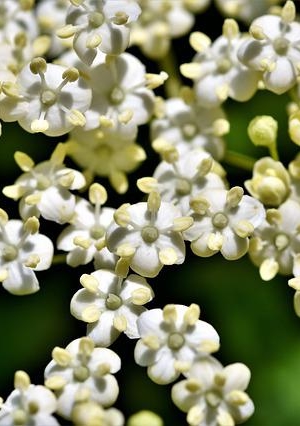
Flower color: white
Habitats: Forest edges, roadsides, hedges, gardens
Danger of confusion: with the poisonous red elderberry, whose berries are red and the flowers smell very unpleasant,
grows mostly only in the forest
Toxicity: partially toxic
Warnings: Leaves and Stems are poisonous. Only eat the berries when ripe and cooked.
They are known to cause stomach upsets to some people.
Any toxin the fruit might contain is liable to be of very low toxicity and is destroyed when the fruit is cooked.
Ingredients: essential oils, bitter substances, carotenoids, flavonoids, glycosides, potassium, vitamin A, vitamin B, vitamin C
Properties: stimulating, antibacterial, expectorant, sedative, blood purifier, detoxifier, relaxant, anti-inflammatory, antipyretic, diuretic, cardiotonic, tonic, expectorant, analgesic, diaphoretic
Helps with: eye weakness, high blood pressure, bronchitis, colds, fever, gout, sore throat, urinary tract infections, cough, nervousness, rheumatism
Plant uses
Cooking:
The leaves, bark and unripe berries of the elderberry contain the toxin sambunigrin (a glycoside),
which decomposes at a temperature of 76.3 °C or higher.
When eaten raw, the leaves, unripe elderberries and uncooked ripe berries have a mildly toxic effect
in larger quantities. Nausea and vomiting may occur.
Therefore, these parts of the plant should never be consumed raw, but should be boiled.
Health:
AIt is useful in treating many ailments including bruises, hayfever, colds, and fevers.
Its teas good for soothing coughs and sore throats.
Beauty:
Soothing and nourishing effect on the skin